
Is Business Analysis a Profession, a Competency or a Research discipline?
Business analysis is a crucial process that drives change within an enterprise. By defining the needs of an organization and recommending solutions, business analysts ensure that the changes implemented deliver value to all stakeholders involved. This value can take various forms, such as increased efficiency, improved customer satisfaction, or enhanced profitability.
During the business analysis process, various tasks and techniques are employed to establish a strong connection between stakeholders. These activities enable a deep understanding of the organization’s structure, policies, and operations. By comprehending these aspects, business analysts can effectively identify the areas that require improvement or change.
Furthermore, business analysts have the expertise to propose suitable solutions that align with the organization’s objectives. These solutions are tailored to address the specific challenges and opportunities faced by the enterprise. By leveraging their industry knowledge and analytical skills, business analysts play a vital role in helping businesses reach their goals and achieve long-term success.
Business analysis serves as a bridge between stakeholders, facilitating effective communication and collaboration. It empowers organizations to adapt, innovate, and thrive in an ever-evolving business landscape.
Behavioural Skills Business Analysts’ Need
When it comes to business analysis, professionals need to possess a range of behavioural skills in addition to their technical expertise to excel in their roles. Some of the key behavioural skills for business analysts include:
Communication Skills:
Business analysts need to communicate effectively with stakeholders at all levels of the organisation, including technical teams, business leaders, and end-users. Strong verbal and written communication skills are essential for conveying complex ideas and requirements.
Analytical Thinking:
Business analysts should be capable of analysing and evaluating information from various sources to make informed decisions and recommendations. This entails the ability to identify patterns, trends, and discrepancies in data and processes.
Problem-Solving:
Business analysis often involves addressing complex business problems and finding effective solutions. BAs need the ability to approach issues systematically, identify root causes, and propose viable solutions.
Adaptability:
In a dynamic business environment, BAs must be adaptable and open to change. They should be able to pivot quickly and efficiently in response to evolving business needs and market conditions.
As a business analyst, negotiation skills are essential for collaborating with stakeholders, eliciting requirements, and facilitating effective communication between different parties. Whether it’s aligning project objectives, resolving conflicting priorities, or securing resources, the ability to negotiate is crucial. Business analysts often need to balance the needs of various stakeholders while ensuring that the project’s requirements and objectives are met. This calls for astute negotiation tactics, active listening, and the capacity to find mutually beneficial solutions.













Stakeholder Management:
Building and maintaining positive relationships with stakeholders is crucial for the success of a business analyst. This involves understanding the diverse needs of various stakeholders and effectively managing their expectations.
Attention to Detail:
Business analysts are responsible for documenting requirements and ensuring that solutions align with business needs. A keen attention to detail is necessary to accurately capture and analyse requirements.
Listening:
Listening is a crucial skill in effective communication. It involves not only hearing the words being said but also understanding the speaker’s perspective and showing empathy. A business analyst should be good listeners that, pays attention to stakeholders, avoid interrupting, and ask clarifying questions. In today’s fast-paced world, developing strong listening skills is essential for building meaningful relationships and achieving success in both personal and professional settings.
Presentation:
How to create a captivating presentation:
Clear Structure: Organize your content into a clear and logical structure to make it easier for your audience to follow.
Engaging Visuals: Use high-quality images, charts, and graphics to complement your key points and keep your audience engaged.
Compelling Content: Craft concise and impactful content that resonates with your audience. Use anecdotes, quotes, or statistics to add depth to your message.
Effective Delivery: Practice your delivery to maintain a confident and natural speaking style. Make eye contact and use appropriate gestures to connect with your audience.
Q&A Preparation: Anticipate potential questions and prepare thoughtful answers to ensure you can address any inquiries effectively.
Remember, a successful presentation is not just about the content, but also about the delivery and its ability to resonate with the audience.
ROOT CAUSE ANALYSIS
Root Cause analysis is a technique used to assess the symptoms of a problem and find the ultimate cause. Often problems are not clearly studied, and inappropriate solutions are recommended. A business analyst should not make solution recommendations until they understand the underlying cause of the problem.
Root Cause Analysis (RCA) is a crucial process in problem-solving, as it allows for a thorough assessment of the symptoms and identifying the fundamental cause of a problem. By delving into the underlying factors, RCA enables a more comprehensive understanding of the issue at hand, thereby reducing the likelihood of implementing inadequate solutions. It’s essential for a business analyst to refrain from prematurely proposing remedies and instead focus on gaining a deep comprehension of the root cause before formulating any recommendations. This methodical approach improves the chances of implementing effective and sustainable solutions, aligning with the long-term goals of the organisation.
Finding the root cause of an IT problem is not only crucial but also a complex undertaking that requires meticulous attention to detail. Once the underlying issue is identified, it sets the stage for business analysts and other stakeholders to devise and implement comprehensive solutions aimed at preventing similar issues from arising in the future. This initial phase of investigation demands a comprehensive and in-depth analysis of system logs, error messages, and any relevant documentation available. Furthermore, it often necessitates collaborative efforts with other team members or relevant stakeholders to gain a comprehensive understanding of the context in which the problem occurred. By delving deep into these aspects, organisations can ensure that the root cause is effectively pinpointed, allowing for a thorough resolution and significantly reducing the likelihood of a recurrence. This multifaceted approach not only addresses the immediate concern but also contributes to the overall stability and efficiency of the IT infrastructure and processes.

The 5 whys approach is a widely used and effective technique for analyzing root causes, involving delving into the underlying reasons behind an issue by repeatedly asking “why” to uncover the primary cause and its associated factors. This systematic and iterative method encourages a thorough exploration of each “why,” allowing teams to move beyond the surface-level manifestations of a problem and delve into the core issues. By following this approach, organizations can gain valuable insights that go beyond the obvious symptoms, enabling them to address fundamental issues and develop more sustainable and impactful solutions. Furthermore, by identifying deeper-rooted issues, teams can proactively work towards preventing similar problems in the future, thereby contributing to long-term improvement and success.
It is important to note that this method serves as a powerful tool for problem-solving and continuous improvement within organisations. By iteratively probing the reasons behind a particular issue, this approach allows teams to gain a comprehensive understanding of the factors contributing to the problem, while also fostering a culture of inquiry and learning. Additionally, the 5 whys technique encourages collaborative participation, enabling diverse perspectives and insights to be considered, which can lead to more holistic and innovative solutions. As a result, it promotes a proactive approach to addressing challenges and empowers teams to create lasting, impactful changes within their operational processes and systems.
The “Why” Question
is the most valuable tool in a business analyst’s toolkit.
It is used to help dig down to the root cause or underlying reason for a problem or opportunity, enabling a comprehensive understanding and paving the way for effective and lasting solutions. This fundamental question can be utilised at any point in the analysis work, providing insights that may otherwise remain undiscovered. Moreover, it is often employed to assist business or IT stakeholders in articulating their requirements, fostering clear and concise communication. The technique of asking “Why” repeatedly, typically at least five times, proves to be a powerful approach in uncovering the deeper issues that may be overlooked. However, it is noteworthy that the goal is to reach the root reason, and this can sometimes be achieved in fewer than five iterations, depending on the complexity of the situation. This method not only promotes continuous improvement but also empowers business analysts to make informed decisions, enhancing the overall efficiency and effectiveness of the organisation.
The 5 Whys method is undeniably one of the most important techniques that a business analyst can have in their toolkit – and it’s the most natural thing to do. By delving deep into the root cause of a problem, it enables a comprehensive understanding of the underlying issues, paving the way for effective and lasting solutions. This approach not only helps in uncovering surface-level problems but also addresses the fundamental issues that may be overlooked. With its emphasis on continuous improvement and problem-solving, the Five Whys method empowers businesses to make informed decisions and enhances their overall operations.
Business Analysis Core Concept Model
In any field, having a common language and a clear framework is crucial for effective collaboration among professionals and other parties.
This is particularly important in business analysis, where analysts deal with a lot of information, tasks, and relationships. A defined structure and clear concepts help analysts understand their tasks, evaluate resources and skills, and collaborate effectively with colleagues, clients, and authorities. This common understanding forms the basis for discussions, project management, and successful business strategy implementation. An operational framework also allows for identifying key performance indicators, developing business plans, and setting objectives for organisational growth.
This structured approach promotes transparency, encourages innovation, and ensures alignment towards common goals.
The International Institute of Business Analysis defines six fundamental business analysis concepts: Change, Need, Solution, Stakeholder, Value, and Context. These concepts are essential pillars that underpin the practice of business analysis and play a crucial role in the success of organisational initiatives.


BACCM-
- The Solution concept involves the exploration and development of strategies and tactics to address business challenges and meet objectives.
- The concept of Change encompasses the identification and management of changes within an organisation, ensuring a smooth transition from existing processes to new ones.
- Need pertains to the thorough understanding of business requirements and the gap that exists between the current state and the desired future state.
- Stakeholder management is integral to ensuring that the needs and expectations of all parties involved are taken into account throughout the analysis process.
- Value is a key consideration, as it involves assessing the impact and benefits of potential solutions.
- Context provides the necessary framework and environmental factors that influence the analysis.
Together, these concepts form a robust foundation for business analysis, offering a comprehensive framework for navigating complex organisational changes and driving successful outcomes.
CHANGE
A change, essentially, involves altering something. In the realm of business, this alteration, or metamorphosis, arises in response to a necessity. This need for change can stem from internal factors or be prompted by external influences, such as market upheaval, political environment, or natural calamities.
The objective of a business analyst should revolve around executing changes in a manner that enhances the operations of an enterprise. Business analysts utilise various business analysis techniques to manage and implement these enhancements.
The positive transformation of an organisation should elevate its value and mitigate potential setbacks. This may encompass preparing for, instigating, and preventing change.
Preparation involves the business analyst posing inquiries about the subject of transformation, the context in which it will take place, the rationale behind it, and identifying the stakeholders. The responses to these inquiries lay the groundwork for successful implementation of the transformation. Each change brings about certain advantages and drawbacks or expenses.
By instigating and uncovering potential transformations, a business analyst can pinpoint potential issues and discern the course of action that will yield the most value. If, during the analysis, the business analyst concludes that a particular change will diminish value, they endeavour to forestall the impending change or at least minimise its repercussions. This also entails furnishing the organisation with the capability to self-regulate.


The process of identifying and analysing organisational needs forms the bedrock of successful project outcomes. Gaining a deep understanding of the complex array of requirements, be they rooted in problems, opportunities, or constraints, stands as a cornerstone for the business analyst.
Waterfall lifecycle
The waterfall lifecycle, also known as the waterfall model, is a classic software development methodology proceeding through a series of sequential stages. In theory, each stage is reviewed and signed off before the next one begins, to ensure a structured and controlled progression. For instance, analysis would commence once a feasibility study has been approved, and the design phase is based on an agreed set of requirements delivered by the preceding analysis stage. This approach is often favoured in projects where the requirements are clearly understood and unlikely to undergo significant changes during the development process. However, the rigidity of this model can make it challenging to accommodate alterations once a stage has been completed, highlighting the importance of thorough initial planning and documentation.
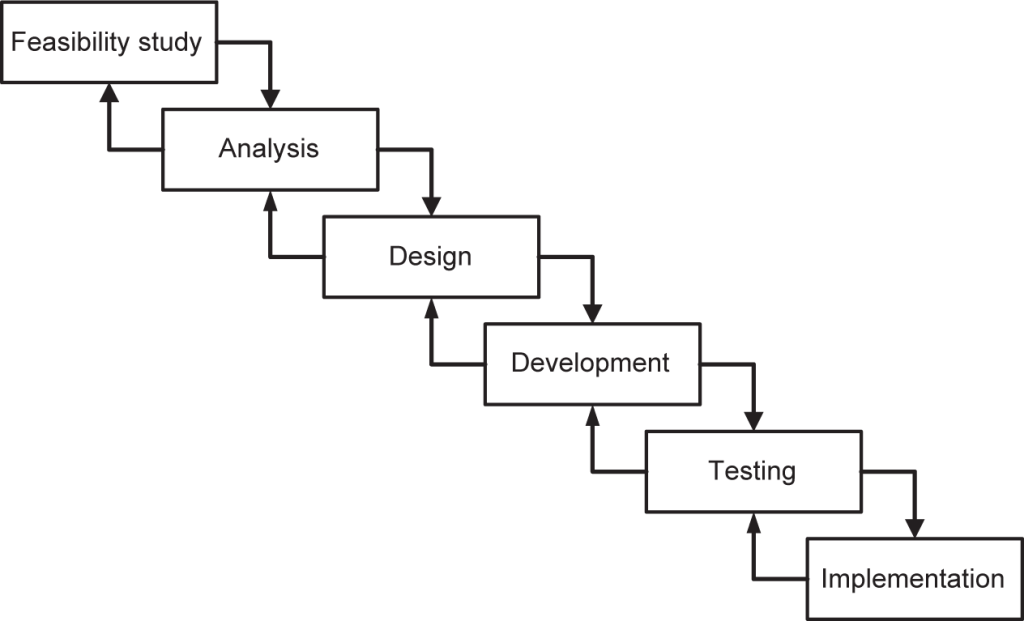
The backwards-facing arrows in the project lifecycle serve as crucial checkpoints, prompting the project team to revisit each stage for a comprehensive evaluation. This recurring assessment helps to verify that the project remains within its defined scope, ensuring that any potential scope creep is identified and addressed early on. Furthermore, it enables the team to confirm that the current stage aligns logically with its predecessor, guaranteeing a seamless transition and progression. Additionally, these checkpoints allow for necessary adjustments to be made to the deliverables from the previous stage, providing the flexibility needed to adapt to evolving requirements and circumstances.
Business analysts play a pivotal role in various stages of the lifecycle. Primarily, they are heavily involved in the feasibility study and analysis stages, where they meticulously assess the practicality and potential obstacles associated with the proposed project. Furthermore, their expertise is often sought during the user acceptance testing phase, aiding in ensuring that the system aligns with the end user’s needs and expectations. Their contribution extends to the implementation stage, where they collaborate closely with business staff, providing valuable insights and guidance throughout the process. In addition, their involvement may also encompass the design and development phases, as they address inquiries regarding business and solution requirements and extend support to software designers and developers as needed. This multifaceted involvement not only underscores the significance of business analysts in the project lifecycle but also underscores the breadth of their impact on project success.
 Rahefetano